.png)
Gloucester Caliman Coxe (1907 – 1999)
Updated: Mar 14

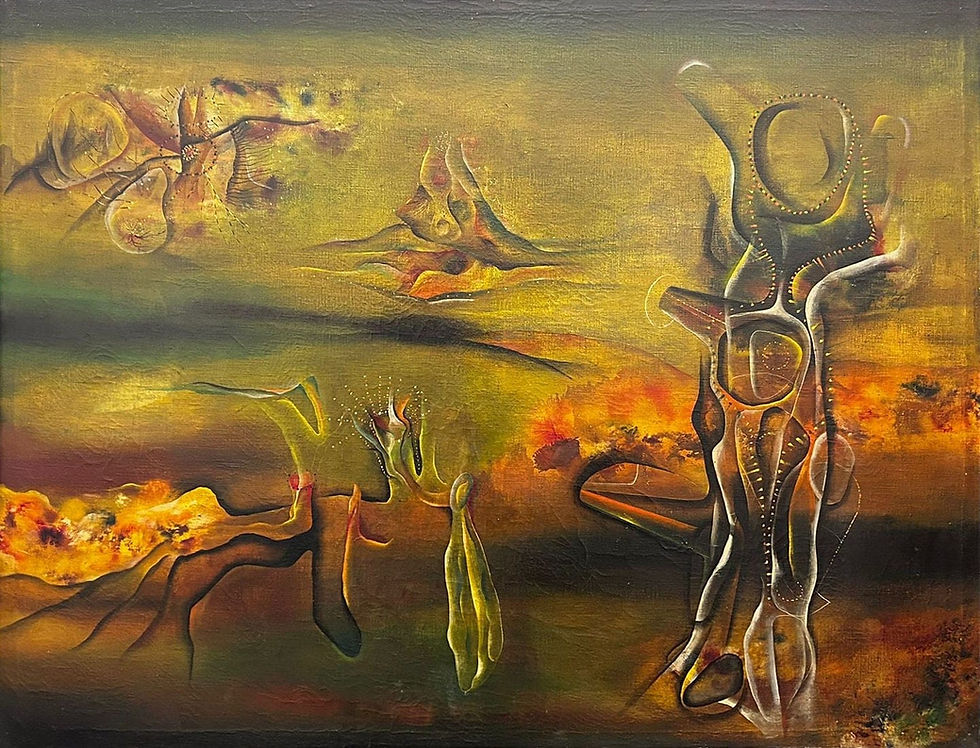
Gemini 41A, 1976, oil on canvas, signed lower right, 60 x 40 ¾ inches, inscribed verso “G. Caliman Coxe / Gemini 41A / oil – 76 / 40 ¾ x 60 / 40+”; label verso reads” “G. Caliman Coxe / Gemini 41A / Oil on Canvas / 40 ¾ x 60 / $4,000 / For Sales and Information Please call Roanne Victor 502-582-1265”; likely exhibited at the Art Gallery of The Actors Theater of Louisville, Kentucky
SOLD
During the last four decades of the 20th century, Gloucester Caliman Coxe was known as Dean of Louisville’s Black artists, high praise considering Coxe’s contemporaries included Bob Thompson, Sam Gilliam, Victor Young, and Ed Hamilton. Although a multi-faceted artist who worked in a variety of media, Coxe is best known for his luminous large-scale abstract oil on canvas paintings, like Gemini 41A, as well as for his role as a teacher and mentor to Louisville’s younger Black artists.
Coxe was born in Carlisle, Pennsylvania, but resided in Louisville, Kentucky from 1924 until his death in 1999. Coxe graduated from Central High School, a venerable, but segregated, institution which was a symbol of pride for Louisville’s Black community. Coxe also studied art at the Bougard College of Music and Arts, which had been founded in 1927 to provide arts education for aspiring Black students living in the west end of Louisville.
In his forties, Coxe was awarded a Hite Art Scholarship to the University of Louisville and in 1955, at age forty-eight, he became the first black artist to graduate with a degree in fine arts. Thompson, and Gilliam, both fellow Central High alums, followed in Coxe’s footsteps, attending the University of Louisville which became a locus of learning for Black artists and abstract painting in the upper South.
Coxe earned a living as a sign painter for local theaters and as an illustrator at the nearby military base, Ft. Knox. In 1959, Coxe, together with other artists, including Thompson and Gilliam, founded Gallery Enterprises in the back of the Brown Derby nightclub, providing a venue for Black artists to exhibit their work. Gallery Enterprises also hosted poetry readings, music concerts and discussion groups. In the mid-1960s, the artists of Gallery Enterprises founded the Louisville Art Workshop, under Coxe’s leadership. Other artists associated with the Workshop included Young, Fred Bond, Robert Carter, Robert Douglas, and Houston Conwill. The artists Coxe taught and mentored remembered him as patient, kind, gentle and caring. One recalled, “He took that time with you; he was not a rushed person.” Coxe was honored at the Fifth Annual African American Invitational Art Exhibition for his positive impact on the Black art community in the upper South. Coxe used his art platform to become a community leader, speaking out on topics ranging from urban renewal to segregation in his adopted hometown.
From the late 1950s through the end of his life, Coxe exhibited in solo and group exhibitions, including at the University of Louisville, Evansville Museum of Arts and Sciences (Indiana), Actors Theater of Louisville Art Gallery, Spalding College Art Gallery, and Hanover College Art Gallery (Indiana), among many others. In 1980, David Driscoll selected one of Coxe’s Gemini paintings for the Second Annual Black Artists Exhibition at Louisville’s First National Tower. The work won the $500 Brown-Forman Distillers Corp. purchase prize. Later, in 1985, Gilliam selected Coxe’s work for inclusion in the Washington DC juried exhibition “Capital Art from Kentucky.” Coxe also exhibited with Washington DC’s Smith-Mason Gallery in the 1970s. Coxe was honored with the Governor’s Award by the Kentucky Arts Council in 1987.
Coxe had his first full retrospective at Louisville’s Urban League in 1991. A second retrospective of seventy-two works, Gloucester Caliman Coxe: A Retrospective: Rags and Wires, Sticks and Pantyhose Too, followed in 1995. In his short catalog essay for this show, Gilliam wrote, “G. C. Coxe’s art is as youthful as wet, colorful paint.” Kenneth Young added, “G. C. Coxe is an artist as hero … one of the great ones. Paul Gauguin once said: ‘There are two kinds of artists – revolutionaries and plagiarists.’ G. C. Coxe is . . . a true revolutionary.’” Fellow creatives often described Coxe as “a painter’s painter.” Art critic Diane Heilenman noted Coxe was “an artist skilled in the manipulation of materials, immersed in spatial abstraction and consistently pulled toward technical experimentation.” Coxe generally worked in self-described periods, including “Ebony Plays,” “Ebony Sleeps,” and the “Exodus Series.” During the 1970s into the 1980s, Coxe worked on dozens of paintings from his “Gemini Series” which are characterized by an ”organic, muscular roundness of forms.” His work has been labeled “Purist Funk” and Heilenman observed that “Coxe’s works can be read as part of a trend toward complexity in non-objective art, even though their garish colors and aggressive graphic qualities also fit what’s come to be called the black aesthetic.”
A posthumous Exhibition of Coxe’s paintings was mounted at Louisville’s Filson Club in 2017. The Speed Art Museum (Louisville) also hosted a solo exhibition for Coxe in 2025. The Speed Art Museum (Louisville), Filson Club (Louisville), and the Johnson Collection (South Carolina) hold Coxe’s art. Coxe is listed in Who was Who in American Art and other standard references.


Comments