.png)
Erle Loran (1905 - 1999)
- May 31, 2025
- 3 min read
Updated: Jul 14, 2025

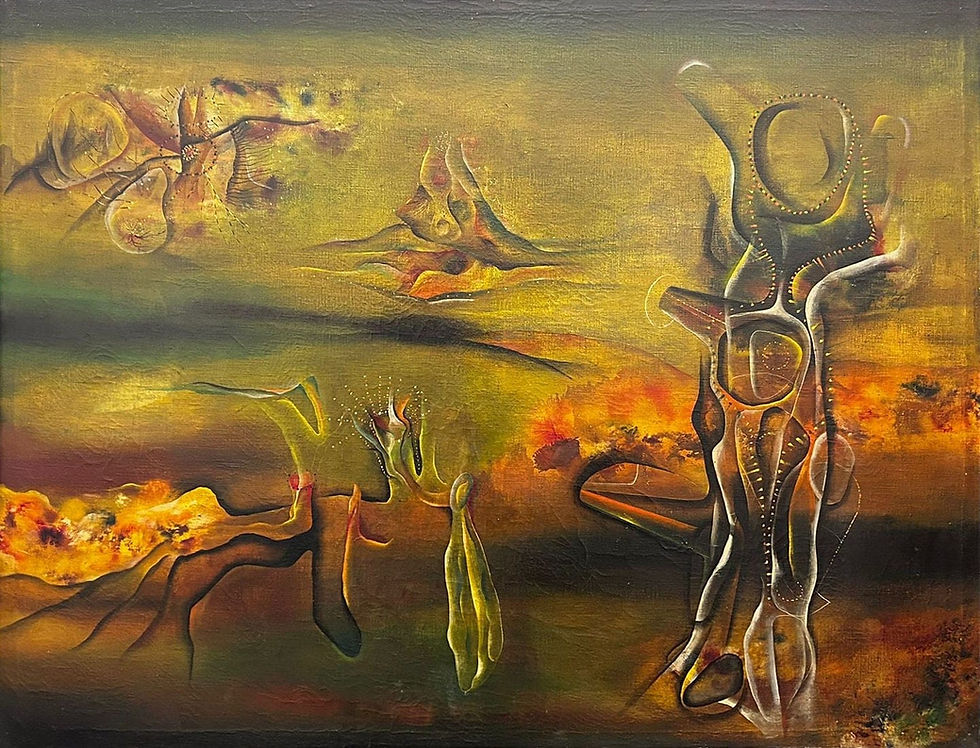
Blacksmith (Untitled), 1936, oil on canvas, signed and dated lower right, 28 x 30 inches
$5,500
Erle Loran was an influential American painter, art historian, and educator, renowned for his contributions to modernist art and his scholarly work on Paul Cézanne. Born in Minneapolis, Minnesota, Loran briefly attended the University of Minnesota before enrolling at the Minneapolis School of Art (now the Minneapolis College of Art and Design), where he studied under Cameron Booth and graduated in 1926. That same year, he was awarded the Chaloner Foundation’s Paris Prize, enabling him to study in Europe. During his time abroad, Loran immersed himself in Cézanne’s world, even residing in the artist’s former studio in Aix-en-Provence. This experience profoundly influenced his artistic direction and led to his seminal book, Cézanne’s Composition (1943), which offered in-depth analyses of Cézanne’s formal structures.
Upon returning to the United States in 1930, Loran settled in New York City, where he exhibited his work and contributed art criticism to various publications. After contracting tuberculosis, he returned to Minneapolis and participated in the Public Works of Art Project during the Great Depression, focusing on regional Minnesota scenes. In 1936, Loran joined the faculty of the University of California, Berkeley, where he taught until his retirement in 1973. He served as chair of the Art Department from 1952 to 1956 and was a central figure in the “Berkeley School” of modernism, influencing artists such as Richard Diebenkorn and Elmer Bischoff.
Loran’s art from the 1930s and 1940s reflected a dynamic fusion of modernist formalism and American regionalist influences. During this formative period, in works such as Blacksmith (Untitled), Loran experimented with compositional structure under the influence of Paul Cézanne, while also responding to the local landscape and social climate of the United States, particularly in Minnesota and California. His paintings featured carefully structured landscapes and still lifes, using planes of color and subtle tonal shifts to build form. While his subject matter often included Midwestern farmhouses, small-town scenes, and rolling countryside, his approach was analytical and abstracted, emphasizing geometric underpinnings and spatial relationships rather than realist detail. His figurative works from this period, though more rare, share many of the same characteristics including the use of the human form as a compositional element within a broader formal investigation, rather than on expressive realism.
By the 1940s, after moving to California and beginning his tenure at UC Berkeley, Loran’s work evolved further toward abstraction and his palette became lighter and brighter. His California landscapes, interiors, and urban scenes from this period are more experimental in color and design. He continued to deconstruct the visible world into flat interlocking forms and used angular structures and rhythmic patterns, showing a kinship with the early American modernists and the emerging Bay Area abstract painters. While still representative, these works emphasized compositional harmony and formal concerns rather than narrative.
Loran’s work was exhibited widely, including at the Museum of Modern Art in New York (1933), Rockefeller Center (1935), Oakland Art Gallery (1936–1946), San Francisco Museum of Art annuals from 1936, the Golden Gate International Exposition (1939), California Palace of the Legion of Honor (1945), and the California Watercolor Society (1947). His paintings are held in numerous prestigious collections, including the San Francisco Museum of Modern Art, the Metropolitan Museum of Art in New York, the Oakland Museum of California, the National Gallery of Art, and the Philadelphia Museum of Art. He is listed in Who Was Who in American Art and all other standard references.


Comments