.png)
Eugene M. Dyczkowski (1899 – 1987)
Updated: Aug 27, 2025

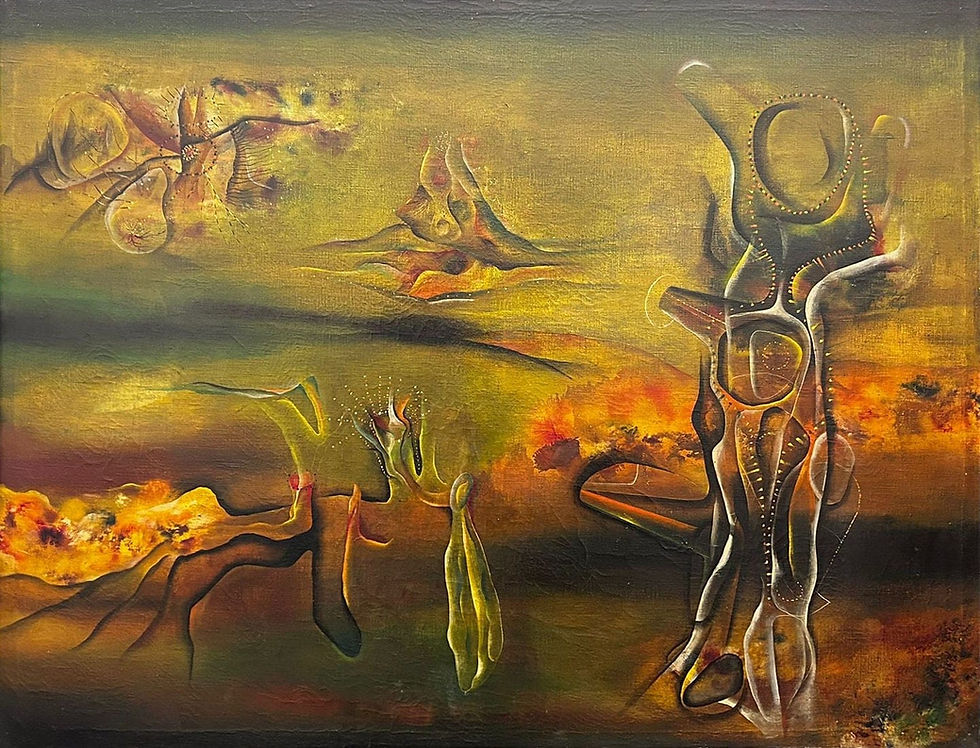
Civilization, c. 1948, oil on canvas, signed lower left, 20 x 24 inches, label verso reads “Eugene M. Dyczkowski / Grand Inland, N. Y. / Civilization,” inscribed verso in the artist’s hand: “Eugene M. Dyckowski / Grand Island N. Y. Price [illegible],” Rochester NY Framer’s stamp verso and titled “Civilization,” exhibited: Buffalo Society of Artist’s Exhibition, Albright Art Gallery (AKG Art Museum), October, 1948 (see Gallery Presents Buffalo as Artists See It; Waterfront Scene Beautifully Painted, The Buffalo News, October 2, 1948)
$7,500
Eugene Matthew Dyczkowski was a multifaceted American artist known for his contributions as a painter, illustrator, muralist, cartoonist, and educator. Born on May 1, 1899, in Philadelphia, Pennsylvania, he relocated with his family to Niagara Falls, New York, in 1917. Dyczkowski began his studies with cartoonist Eugene Zimmerman. He further honed his skills at the Albright Art School in Buffalo and the Buffalo School of Fine Arts, learning from instructors such as John Rummell, Arthur Lee, and Eliot O’Hara. His early works encompassed bucolic landscapes, urban scenes, and figure studies, often reflecting a realist style infused with a strong sense of color.
In 1924, Dyczkowski was featured in his first exhibition with the Buffalo Society of Artists, marking the beginning of a prolific exhibition career. He showed extensively, including at the 1929 World's Fair in Warsaw, Poland and dozens of exhibitions from the 1920s through the 1950s with the Buffalo Society of Artists, The Patteran, the Niagara Falls Society of Artists, the Rockport Art Association, the Kenmore Art Society, the Polish Arts Club (Co-founder and First President), and the Grand Island Art Club. He had a solo exhibition at the Albright Art Gallery (now AKG) in 1944 and was honored with a traveling exhibition in 1946. He won multiple prizes, including with the Buffalo Society of Artists. Dyczkowski also served as Educational Director of the Albright Art Gallery (now AKG). During the 1930s, he worked for Works Progress Administration (WPA) as a muralist, creating notable pieces including Defending Forts at Fort Niagara State Park and murals at Burgard Vocational High School in Buffalo.
During the 1940s, Dyczkowski’s American Scene paintings took on a lyrical painterly quality even when depicting a belching locomotive leaving a factory. The present work, Civilization, is a prime example of Dyczkowski’s paintings from this period. When the canvas was exhibited at the Buffalo Society of Artist’s Exhibition at the Albright Art Gallery (now AKG) in 1948, a local art critic wrote “There is a universality about Eugene Dyczkowski’s picture of a factory encroaching on green fields, wryly entitled ‘Civilization,’ that makes the canvas transcend mere locality.” In the 1950s, his artistic style underwent a significant transformation from realism to abstract expressionism making Civilization among the last group of Dyczkowski’s American Scene paintings.
Dyczkowski was deeply involved in promoting Polish-American culture. He co-founded the Polish Arts Club of Buffalo in 1944 and served as its first president from 1945 to 1946. His efforts with the club raised awareness about the significance of Polish heritage and promoted Polish culture. Following the club's first national conference, he was elected as the first president of the American Council of Polish Cultural Clubs. Eugene Dyczkowski passed away in 1987, leaving behind a legacy that continues to be appreciated for its historical and artistic significance. His paintings are part of collections of the Burchfield Penney Art Center in Buffalo, the Castellani Art Museum at Niagara University, and the Tennessee State Museum, among others.


Comments