.png)
William C. Palmer (1906 - 1987)
- May 29, 2025
- 2 min read
Updated: Aug 6

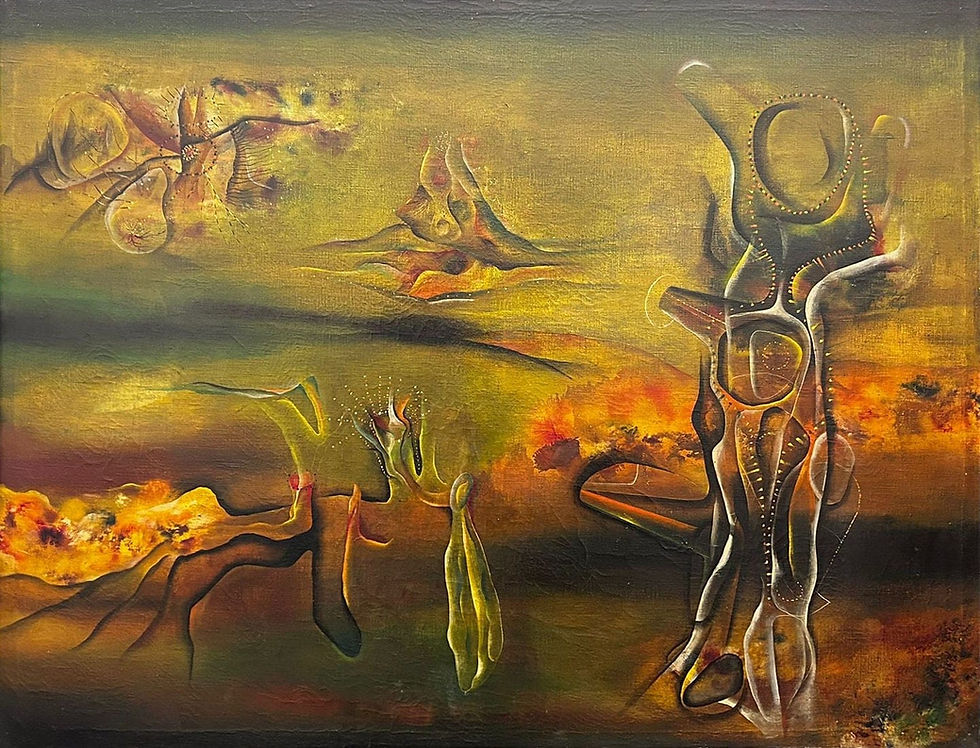
Indolent Interlude, 1936, oil on board, signed and dated lower middle, 12 x 16 inches, signed verso and inscribed with title and date, exhibited Uncommissioned Portrait Exhibition, American Federation of Arts, traveling show, 1941-42, venues included the California Palace of the Legion of Honor, San Francisco, CA (label verso) and Rembrandt Hall, Pomona College, Pomona, CA (see Portraits Showing At College Collection of Uncommissioned, The Pomona Progress Bulletin, 1942 - "The titles suggest caricature and abstractions of people sprawled comfortably over the canvas: . . . 'Indolent Interlude' by William C. Palmer."); provenance includes: Midtown Galleries, NY (label verso), Dayton Art Institute, Dayton, OH, and Munson-Williams-Proctor Institute Museum of Art, Utica, NY (label verso)
SOLD
William C. Palmer’s style in the 1930s when he painted Indolent Interlude was a form of precise realism rooted in the American Scene. The painting captures a moment of languid leisure during the Great Depression, offering a rare image of repose amid a turbulent era. The figures rest beneath beach umbrellas, their sun-warmed bodies rendered in soft, earth-toned hues. With echoes of classical composition Palmer fuses serenity and social observation. The title underscores the painting’s gentle irony—an idle pause in a decade more commonly defined by national struggle. Markedly different from depictions of heroic workers, powerful industry, the downtrodden urban or rural poor and political strife, Indolent Interlude captures a quiet intimate moment of restful reflection at the seaside.
William C. Palmer was an American painter and muralist known for his contributions to public art and American Scene painting during the mid-20th century. Born in Des Moines, Iowa, Palmer trained at the Art Students League of New York, where he studied under notable artists such as Boardman Robinson and Thomas Hart Benton. He later studied fresco painting in Italy and Mexico, gaining expertise in large-scale public works. Palmer gained national attention during the New Deal Era, creating murals for several federal buildings under the Treasury Section of Fine Arts. His works appeared in post offices and courthouses across the United States, including in Monticello, Iowa; Arlington, Massachusetts; and Poughkeepsie, New York. These murals reflected a regionalist style, often depicting agricultural labor, industrial scenes, and local community life with clarity, dignity, and subtle lyricism. In addition to public commissions, Palmer exhibited at major institutions including the Whitney Museum of American Art, the Metropolitan Museum of Art, the Corcoran Gallery, and the Pennsylvania Academy of the Fine Arts. His paintings are held in the permanent collections of the Metropolitan Museum, the Smithsonian American Art Museum, and the National Gallery of Art, among others. He was also deeply engaged in arts education, serving as the founding director of the Munson-Williams-Proctor Institute School of Art in Utica, New York, where he taught for decades. Palmer is listed in Who Was Who in American Art and all other standard references.


Comments