.png)
Charles H. Walther (1879 - 1937)
Updated: Jul 29

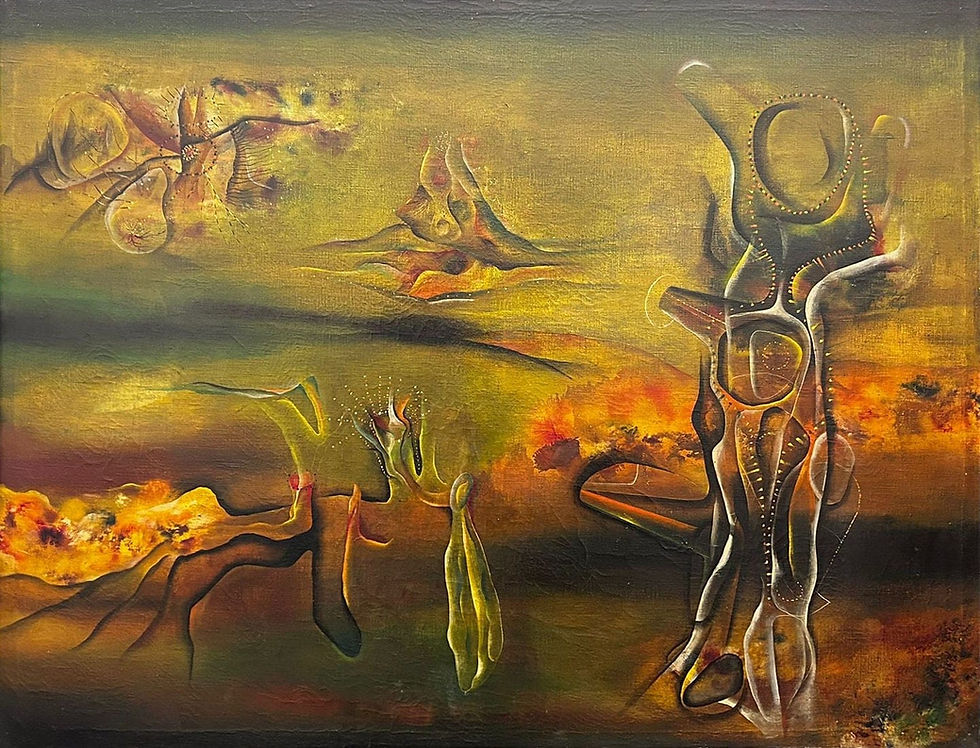
Reversible Composition, c. 1937, oil on composition board, signed verso in pencil, 12 x 15 / 15 x 12 inches, “#11” “22” and #104” annotated verso, label verso reads on one side: “Charles H. Walther / American 1879-1938 / Reversible Composition / 12 x 15 inches / oil on board” and on the other side: “Inglett-Watson / Art Deco / Style Moderne / 884 Park Ave. at W. Chase / Baltimore, Maryland 21201 / 301 244 8064", literature: American Fine Art Magazine, Issue 81, May/June, 2025 (illustrated as cover), provenance includes: Inglett-Watson, Baltimore, presented in a newer frame
$7500
Charles H. Walther was Maryland’s leading early modernist. A native of Baltimore, Walther trained at the Maryland Institute before decamping to Paris in 1906 where he studied with Jean Paul Laurens at the Académie Julian and later with Blanche L. Simon & Cottet. After studying in Europe, he returned to Baltimore and joined the faculty of the Maryland Institute College of Art, where he taught for more than two decades before being ousted for his modernist leanings. He exhibited at the Peabody Institute Gallery in Baltimore in 1912 and again in 1914. While visiting the 1913 Armory Show in New York, Walther became friends with Charles Sheeler, Maurice Prendergast, and Water Pach who tried to convince him to remain in New York. Although he elected to return to Baltimore, Walther was a founding member of the New York-based Society of Independent artists. By 1914, Walther began a series of modernist compositions influenced by Cubism and Futurism, which he exhibited in New York and Baltimore. As early as 1915, Walther exhibited at New York’s prominent Montross Gallery. In 1920, protesting against the prevailing academic approach to art, Walther became a founder of the Society of Baltimore Independent Artists, which held non-juried shows. His work attracted the attention of Alfred J. Barr, future director of the Museum of Modern Art, and art collector Duncan Phillips who purchased several paintings in 1923. After his dismissal from the Maryland Institute College of Art in the late 1920s, Walther continued to teach privately and push the boundaries of modernism, including adopting a fully Non-objective style.
In the mid-1930s just before his death in a car accident, Walther painted at least two Reversible Compositions, the present work and a larger 1937 work which is in the permanent collection of the Baltimore Museum of Art. Walther conceived of the paintings so that any of the four sides could serve as the top of the work and imbued each with the dynamic motion and geometry associated with the Futurist and Constructivist movements. Walther did not sign these works on the face of the board so that they could be rotated and displayed in all four permutations. At least one Reversible Composition was included in Walther’s solo Memorial Exhibition at the Baltimore Museum of Art in 1939. An obituary summed up Walther’s importance, “At a time when Baltimore was singularly ignorant of these [Modern] movements and hostile to the mildest evidences of them, Mr. Walther was patiently studying, elucidating and experimenting with them. He paid for it, of course, in hoots and cheap witticisms and in the loss of his academic post, but in the end he had his vindication, for today Baltimore no longer thinks of notable modernist painters as mere charlatans or wild men. It is difficult to estimate the role Mr. Walther played in that gradual and important enlightenment, but certainly it was a major part.” He is listed in Who Was Who in American Art and all other standard references.


Comments