.png)
Abraham S. Weiner (1897 - 1982)
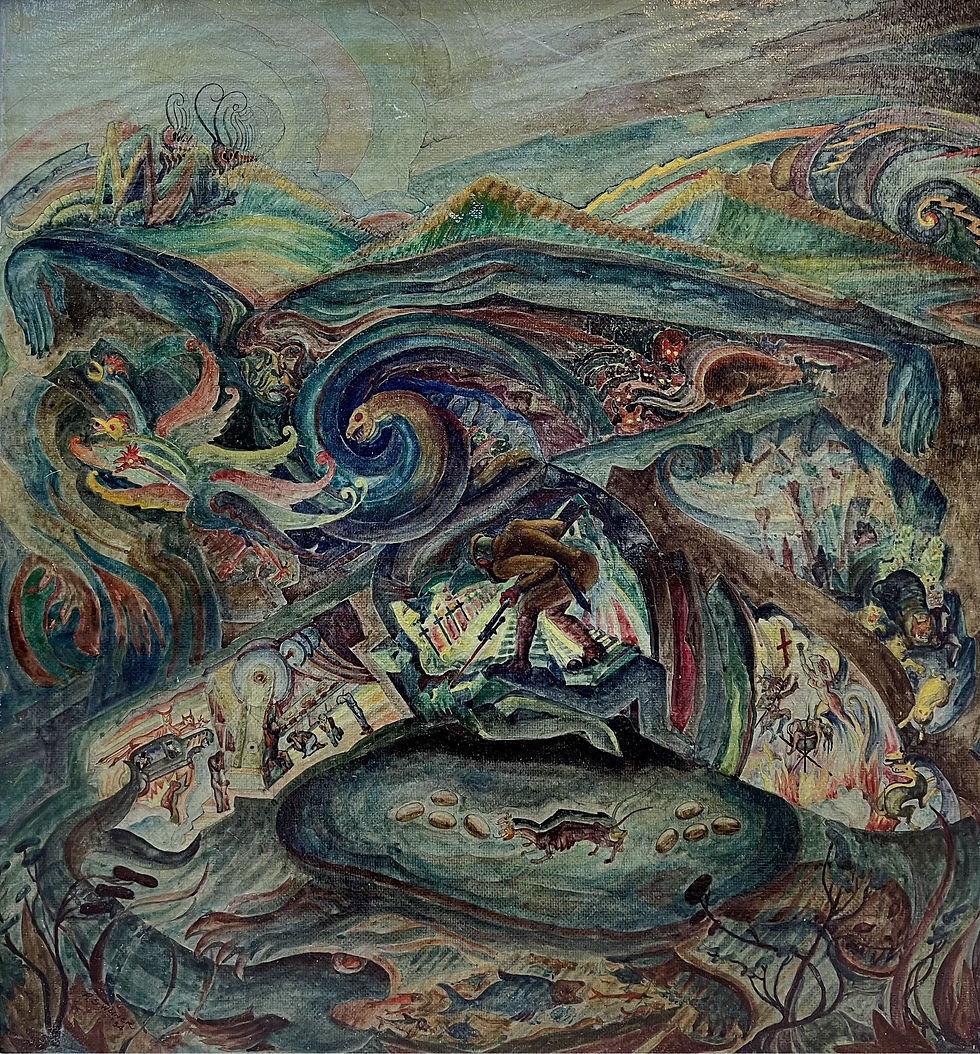
Underground, 1934, mixed media on Masonite, signed and dated lower left, 24 1/4 x 22 1/4 inches, label verso reads: "#62 / Underground / (244) / A. S. Weiner," presented in its original frame
SOLD
Abraham S. Weiner was a Russian-born American artist whose work included Midwestern Regionalism, Social Realism, and modernism. Born in Russia in 1897, Weiner immigrated to the United States as a child and eventually pursued formal art training at the University of Michigan, Art Institute of Chicago, Studio School of Art in Chicago, and privately with Alexander Archipenko. His early years in Chicago exposed Weiner to the socially engaged currents of American art during the interwar period, influencing his interest in depicting ordinary people and urban and rural environments, as well as Surrealist inspired paintings which explored the human condition. Like an updated Hieronymus Bosch, Weiner's Underground is filled with magical beasts, vignettes of war and torture, and seemingly mythological and biblical images of the artist's own creation. Being a product of his times, Weiner also included images of a rich capitalist in chauffer-driven limousine and an industrial accident with a grieving family and co-worker looking on as a worker appears to be crucified on the whirling belts and gears of a machine.
Weiner contributed to the era’s broader movement of socially conscious art, producing linocuts and woodcuts that shared affinities with New Deal printmaking. One notable example is Milk and Honey (c. 1937–38), a linoleum cut which was part of the fifteen-artist Biro-Bidjan Portfolio, a copy of which is now in the collection of the Whitney Museum of American Art. Another print from the same period, Untitled (Man, Heads), is also represented in the collection of the National Gallery of Art. While working in the Midwest, Weiner exhibited at the Art Institute of Chicago, Northwestern University, and Cornell University. After relocating to Los Angeles before 1943, Weiner worked as a set designer for 20th Century Studios while continuing his fine art practice. Southern California became an important center for his career, and he quickly established a strong exhibition record. He had solo exhibitions at the San Francisco Museum of Art in 1943, University of California, Los Angeles in 1943, and the Los Angeles County Museum of Art in 1945. He also exhibited with organizations including the California Water Color Society, the Glendale Art Association, and the Los Angeles Art Association. He is listed in Who Was Who in American Art and all other standard references.


Comments