.png)
Conrad Buff (1886 - 1975)

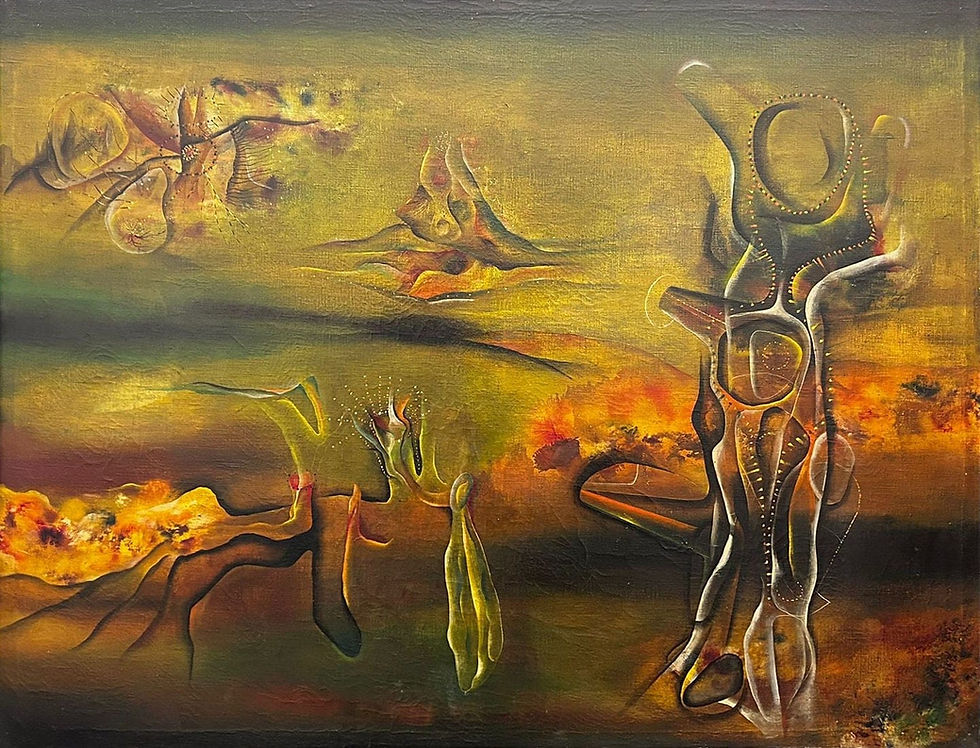
Dam and Power Plant (Untitled), third quarter 20th century, oil on paper on panel, signed lower right, 30 x 24 inches, presented in a newer frame
$4,750
Conrad Buff was a Swiss-born painter who spent most of his artistic career in California, where he established a reputation for depicting the American Southwest. As a young man, he apprenticed as a baker and later entered trade school to study lace design, a background which likely influenced his approach to paint application. After studying briefly in Munich, he emigrated to the United States in 1905, first working in Wisconsin as a sheepherder. By 1907, Buff relocated to Los Angeles where he worked as a gardener, baker, cook, and house painter while also pursuing fine art. He was largely self-taught.
Buff had his first solo exhibition at the Los Angeles County Museum of Art in 1920 and he showed regularly around southern California over the following two decades. He was a member of the California Art Club and associated with important early West Coast landscape painters such as William Wendt, Guy Rose, and Jack Wilkinson Smith, but he shared little with them stylistically. Buff’s work was characterized by an angular, modernist style using strong color applied in a pointillist manner, with cross hatching or in bold expressive strokes. His landscapes emphasized geometric forms laid out in flat patterns.
In 1922, Buff married artist and museum curator, Mary Marsh. In 1936 they began collaborating on children's books which Mary wrote, and Conrad illustrated. Nature and the environment, Native Americans, and Switzerland constituted the themes of most of the thirteen books they published together. Several were nominated for Newbery and Caldecott awards. Buff's mature paintings, like the present example, became increasingly abstract and he sometimes depicted the built industrial environment which is markedly different from his typical desert and mountain landscapes. Buff is listed in Who Was Who in American Art and all other standard references.


Comments