.png)
Hans Burkhardt (1904 - 1994)

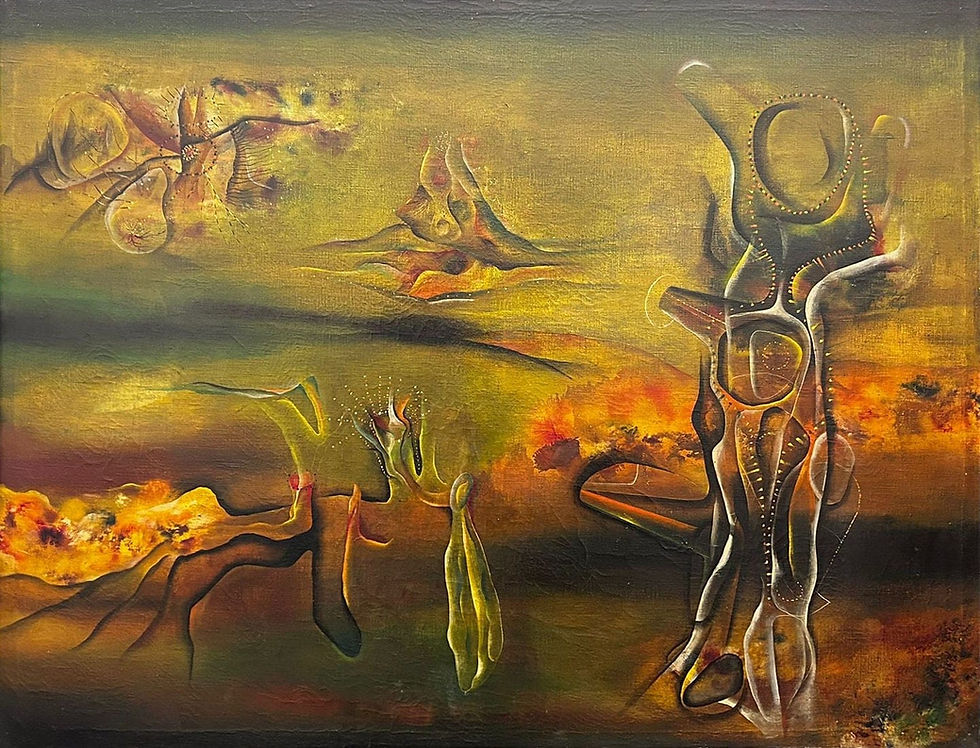
Dancing Figures (Untitled), 1944, oil on canvas, signed and dated lower right, 22 x 34 1/4 inches, presented in its original strip wood frame, from the estate of the artist Ernest Rosenthal
$18,000
Hans Burkhardt was a Swiss-born American painter whose career bridged the development of Abstract Expressionism in New York and Los Angeles. Although less widely known than some of his contemporaries, he is regarded by many art historians as one of the most important and independent voices of twentieth-century American art. His work combined Abstraction and Surrealism with a strong social conscience, particularly through his lifelong opposition to war and violence. Unlike many Abstract Expressionists, he rarely abandoned recognizable subject matter entirely. Instead, he fused expressive abstraction with humanistic concerns, producing emotionally charged paintings that addressed the Spanish Civil War, World War II, Hiroshima, Vietnam, and later conflicts in the Middle East. Burkhardt was among the earliest American artists to use Abstraction as a vehicle for political protest. Invoking series like Los Caprichos and Los Desastres de la Guerra, art historian Eugene Anderson proclaimed Burkhardt as "Goya's spiritual heir."
Burkhardt's work was often hard-hitting with dark outlines forming challenging imagery reflecting pain, suffering, despair, and even death. Perhaps to heighten the impact of his virulently anti-war paintings, Burkhardt also created seemingly joyous arrangements to celebrate the triumphs of good over evil. Dancing Figures (Untitled) is one such work, which likely reflects the artist's reaction to the Allies' military successes over Nazi Germany during 1944. It is a companion painting to Liberation of Paris, a canvas from the same year, which also employed stylized figures dancing within a pink ground beneath a bright red sun. Writing in 1945 of Burhardt's first solo museum exhibition at the Los Angeles County Museum of Art, where Liberation of Paris was shown (and Dancing Figures (Untitled) may have been exhibited), Los Angeles Times art critic Arthur Millier, noted, "even the unimaginative can scarcely miss the dynamic power and fine color of these symbolic pictures which effect so striking a transfer of feeling into form."
Burkhardt was born in Basel, Switzerland, into difficult circumstances. His father emigrated to the United States when Hans was young, and after his mother’s death from tuberculosis, he spent much of his childhood in an orphanage. At age twenty, he moved to New York to join his father, only to lose him shortly thereafter in an automobile accident. Despite these hardships, Burkhardt pursued art while working as a cabinetmaker and eventually enrolled at Cooper Union from 1925 to 1928. There he formed a close friendship with Arshile Gorky and later associated with artists such as Willem de Kooning. He shared a studio with Gorky for nearly a decade. In 1937 Burkhardt moved to Los Angeles, becoming an important link between the East Coast avant-garde and the emerging California modernist scene. During the 1950s he spent considerable time in Mexico, where local attitudes toward death, vibrant color, and ceremonial traditions profoundly influenced his art. Burkhardt taught extensively and eventually became professor emeritus at California State University, Northridge. In 1992 he received a Lifetime Achievement Award from the American Academy and Institute of Arts and Letters. Throughout his long career, Burhardt exhibited extensively at major museums across the United States and internationally, including the Metropolitan Museum of Art, Museum of Modern Art, Art Institute of Chicago, Whitney Museum of American Art, British Museum, Kunsthalle (Basel, Switzerland), and dozens of others. He is listed in Who Was Who in American Art and all other standard references.


Comments