.png)
Maurice Becker (1889 - 1975)
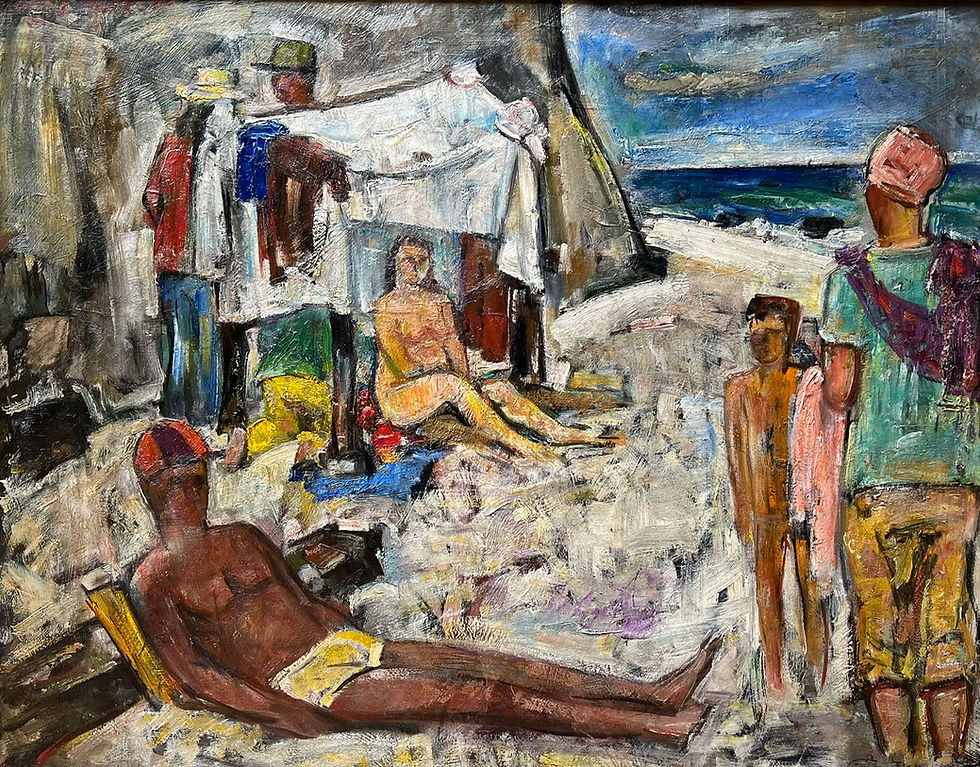
Martha's Vineyard, c. 1951, oil on heavy board, signed upper left, 24 x 30 inches, signed, titled and dated verso, presented in a period frame
$4000
Maurice Becker was a Russian-born American painter, illustrator, and political cartoonist. Although he is best remembered for his contributions to left-wing publications during the 1910s and 1920s, Becker was also an accomplished painter who produced landscapes, urban scenes, and figurative works over a career spanning more than six decades.
Born in Nizhny Novgorod, Russia, to a Jewish family, Becker immigrated to New York City in 1892 at the age of three. His family settled on Manhattan’s Lower East Side, where he grew up amid the vibrant immigrant culture that would later inform his social consciousness. After attending Commercial High School, he worked in garment factories and as a sign painter while pursuing art training. In 1908, he studied at the Art Students League and with Robert Henri, one of the leading figures of the Ashcan School, whose emphasis on realism and everyday urban life profoundly influenced Becker’s artistic development. Becker gained national recognition at a young age when he exhibited at the historic Armory Show in New York in 1913. However, his reputation was largely established through his powerful black-and-white drawings published in radical journals such as The Masses, The Liberator, The Daily Worker, New Solidarity, and The New Masses. His imagery criticized war, inequality, labor exploitation, and political repression, often using humor and human empathy. During World War I, Becker became a conscientious objector and fled to Mexico to avoid military service. Upon returning to the United States in 1919, he was arrested and sentenced to prison, ultimately serving several months before his sentence was commuted.
Beginning in the 1920s, Becker gradually shifted his attention from political illustration to painting. He spent time in Mexico from 1921 to 1923, absorbing its artistic culture before returning to the United States. His later paintings, such as Martha's Vineyard, depicted beaches, fairs, city parks, horse races, markets, and working-class subjects rendered with a lively, expressive sensibility that sometimes seemed to reference works by Marsden Hartley. Throughout his life, Becker remained sympathetic to progressive and leftist causes and maintained associations with Communist-affiliated cultural organizations during the 1930s and 1940s and his work into the 1950s continued to explore concerns for the human condition in the Atomic Age. Writing in 1955 regarding a solo exhibition that displayed Becker's Martha's Vineyard scenes, The Dailey Worker questioned, "Is this merely escapist? No, a thousand times no, in the face of the H-Bomb lunatics. It is affirmation of the loveliness of being alive and human . . . "
Becker exhibited frequently at major museums and institutions across the United States, including the Whitney Museum of American Art, Metropolitan Museum of Art, Art Institute of Chicago, National Academy of Design, and the Carnegie Institute. He was represented commercially by some of New York's most significant galleries, such as J. B. Neumann and MacBeth. His papers are preserved by Archives of American Art, and examples of his work are held by institutions including the Delaware Art Museum. He is listed in Who Was Who in American Art and all other standard references.


Comments