.png)
Naomi Lorne (1902 - 1964)

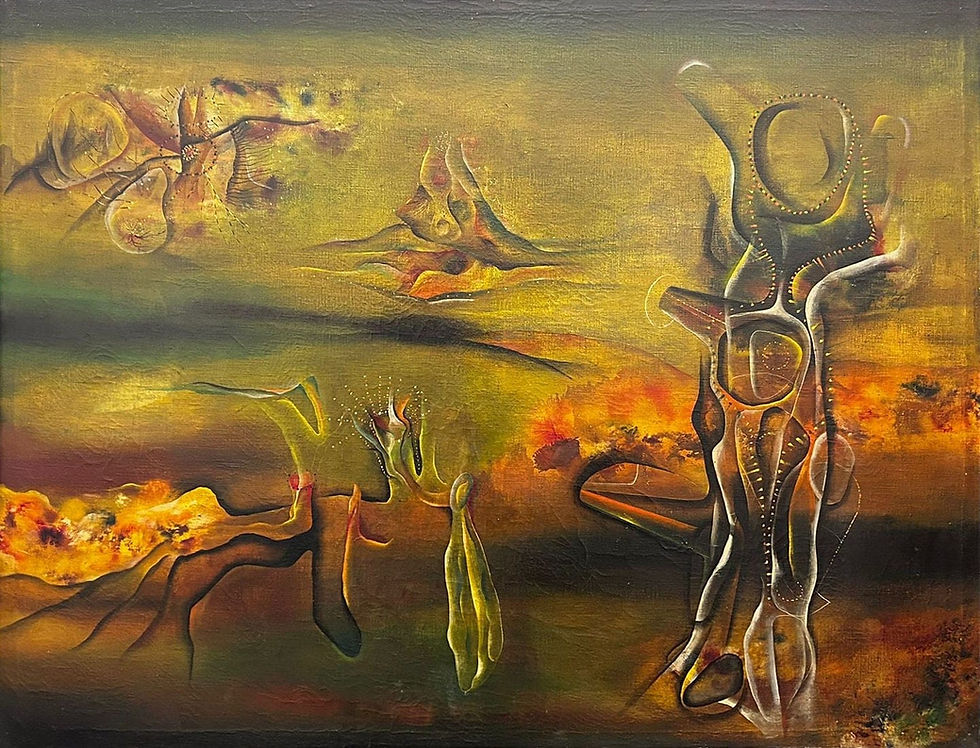
Of The Night, c. 1950s, mixed media on canvas, signed lower right, 10 x 30 inches, artist's label verso reads: "Telephone Gramercy 7-7338 / 'Of The Night' / $350 / Naomi Lorne / 124 East 24th St. / New York 10, N.Y. / Studio Al 4-7620 / East 23 St. N.Y.C.", presented in its original frame
$1750
Naomi Lorne, born Naomi Duckman in Brooklyn, New York, was an American painter and sculptor whose career spanned American Scene painting to Abstract Expressionism. Lorne developed a respected exhibition record and was an active participant in New York’s artistic community during the 1930s through the 1950s. Her work reflected both the strong academic training she received and her willingness to embrace the modernist currents that transformed American art in the decades following the Great Depression. Lorne studied extensively in New York, attending the Art Students League, City College of New York, and Hunter College. She also trained privately with several distinguished artists, including Aldro T. Hibbard, George Bridgman, Abram G. Schulman, and Frederick J. Waugh.
Early in her career, Lorne painted landscapes, coastal scenes, still lifes, and decorative compositions, displaying a sensitive handling of color and structure. By the late 1940s and 1950s, however, she increasingly explored abstraction, producing energetic compositions built from expressive forms and luminous color relationships, such as those seen in Of The Night. Her abstract paintings demonstrated an awareness of the broader developments in American modernism while maintaining a distinctly personal style characterized by rhythmic movement and carefully balanced compositions. During this period, Lorne gained national notoriety for pioneering the art barter movement through which painters exchanged their work for daily necessities, food, electronics, homewares, and luxury goods. She even traded Jackie Robinson painting lessons in exchange for Dodgers tickets.
Throughout her career, Lorne exhibited widely in regional and national exhibitions across dozens of institutions including the Carnegie Institute, the National Academy of Design, and the Whitney Museum of American Art. She belonged to numerous professional organizations, including the Society of Independent Artists, the American Society of Contemporary Artists, the Audubon Artists, the National Association of Women Artists, the New York Society of Women Artists, the Artists Equity Association, and the Silvermine Guild of Artists, among others. These memberships placed her within an extensive network of professional artists and provided regular opportunities to exhibit her work. She is listed extensively with over forty lines in Who Was Who in American Art.


Comments