.png)
Ralph McGuire (1917 - 2006)

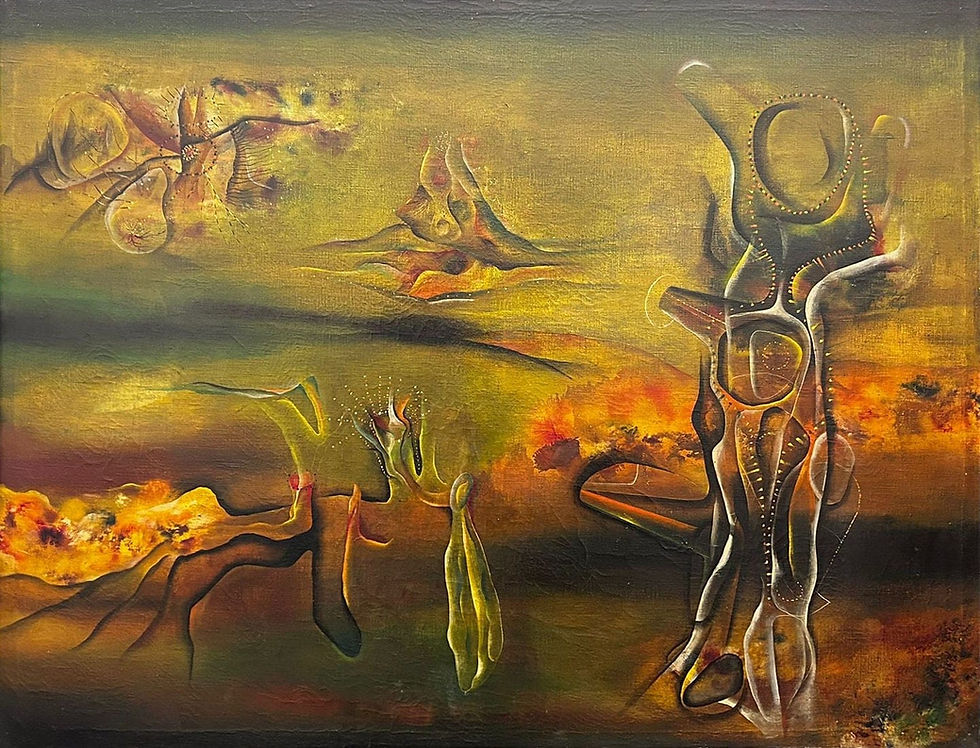
Untitled, 1953, oil on Masonite, signed and dated lower left, 7 x 11 1/2 inches, presented in an older (likely original) frame
$1250
Ralph McGuire was an American painter whose work celebrated the industrial landscapes, waterfronts, and neighborhoods of his native Baltimore, as well as fantastical images of landscapes he created, such as the present work. His oeuvre spoke to a strain of American modernism which drew upon seemingly naive compositions and techniques to explore real and imagined worlds giving rise to a Magic Realist quality.
Born in Baltimore in 1917, McGuire grew up in the Hampden neighborhood as the son of a railroad worker father and a mother who labored at the Jones Valley Cotton Mills. As a child, he played trumpet in a Salvation Army band and was fascinated by the industrial city. He also liked riding the No. 1 streetcar's rambling route from Druid Hill Park to the end of the line at Fort McHenry. He sketched along the way.
"I painted everything," he told a reporter. "I love bridges for their composition. They have very distinct composition. You can put people on them, and under them and trains going over them."
He graduated from Baltimore City College in 1935 and initially worked for the Social Security Administration while pursuing art during his spare time. Rather than attending a formal art academy, he studied locally with influential Maryland artists Herman Maril and Donald Coale. Particularly under Maril's influence, McGuire developed a style characterized by carefully considered simplification of common, recognizable forms. His paintings often incorporated small figures and humorous details, lending his work a sense of warmth and humanity. Fellow Baltimore artist Raoul Middleman described his paintings as “quirky, funky and whimsical,” praising McGuire’s ability to find beauty in ordinary places. At his memorial in 2006, fellow artist Greg Fletcher recalled, "His work had a childlike quality. It was sweet and charming but not naive. He was a sophisticated artist. He often spoke in simple terms and disguised his deep understanding of life in his own humility."
In the 1940s, Mr. McGuire's works caught the attention of Baltimore Museum of Art (BMA) director Adelyn Breeskin. She recommended him for a scholarship at the Phillips Gallery in Washington, where he studied under artist Karl Knaths. Mr. McGuire had a one-man show at the BMA in 1947. A significant purchase of his works amounting to $5,000 by collector James Blankford Martenet enabled McGuire and his wife, artist Tobia Samuels, to establish a framing business in downtown Baltimore. The shop became an important gathering place for local artists, and McGuire supported himself for decades through framing rather than aggressively marketing his own paintings. McGuire recalled, "I felt like a man in the opera; I felt like singing all the time. I had enough money to live on for three or four years. I felt sort of carefree." In 1959, Mr. Martenet committed suicide and left his collection to the BMA.


Comments