.png)
Roman Maraz (1911 - 1979)

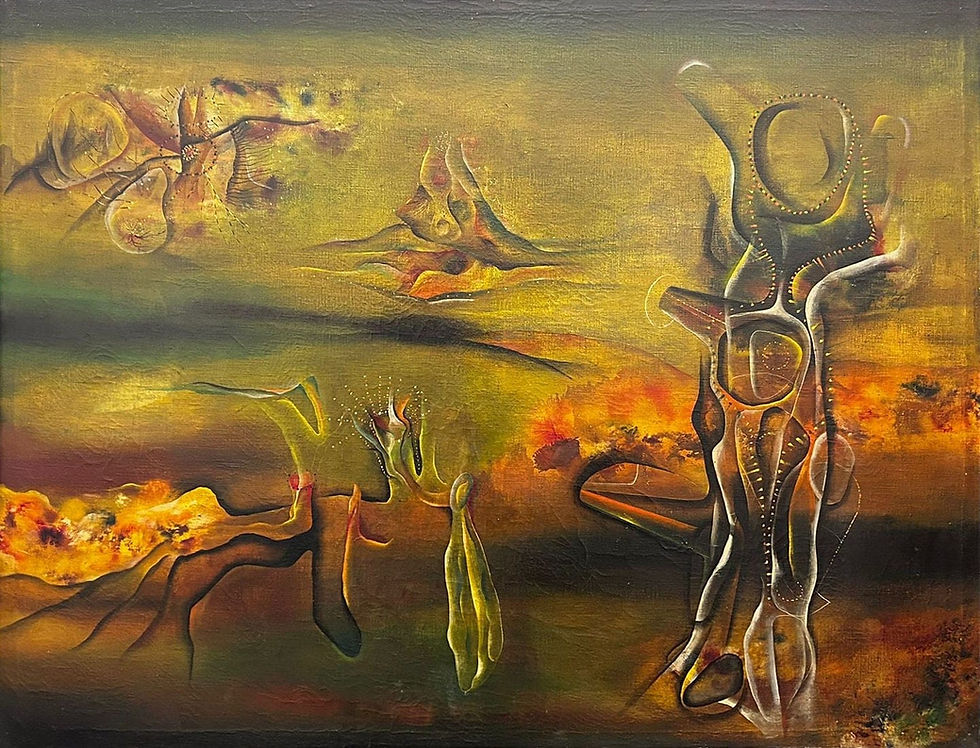
That Which Passes, c. 1950, oil on board, signed lower right, 24 x 34 inches
$3250
Roman Maraz was an American painter, designer, and educator whose work reflected modernist trends in the American Midwest. His work is often characterized by an uncanny Magic Realist quality, which is evident in That Which Passes. Describing his work in 1941, an art critic noted, that Maraz "is free of shallow realism while he portrays the American landscape with considerable strength and insight . . . All together he has produced work of great maturity with a fine grasp of form and composition for an artist of his years."
Born in Ukraine in 1911, Maraz immigrated to Canada as a young man and enrolled at the Ontario College of Art in Toronto in 1929, where he was a scholarship recipient. His early academic training emphasized traditional draftsmanship and design, providing him with a strong technical foundation. Seeking advanced study, he moved to Michigan after receiving a fellowship to the Cranbrook Academy of Art, where he studied from 1939 to 1941 under Zoltan Sepeshy. Following his studies, Maraz became an active participant in Michigan’s vibrant art scene. He exhibited regularly at the Scarab Club in Detroit (prizes and solo exhibition), the Detroit Institute of Arts, Cranbrook Academy of Art, Ontario Society of Artists, Michigan State Fair, Michigan Academy of Science, Arts and Letters, and the University of Michigan Museum of Art. These venues placed him among a generation of regional artists who balanced representational subjects with increasingly modernist visual languages. His paintings ranged from carefully observed rural and urban landscapes to imaginative Magic Realist compositions rendered in watercolor, egg tempera, acrylic, and mixed media. Over time, his work evolved toward abstraction while retaining a strong structural sense inherited from his academic training.
Maraz was also an accomplished educator. From 1945 until 1952 he taught at the Meinzinger Art School in Detroit. Beyond painting, his talents extended into commercial and architectural design. He designed buildings for the Ford Foundation in Dearborn, Michigan, stage sets for Columbia Pictures in Los Angeles, and advertising for General Motors.


Comments