.png)
Theodore Roszak (1907 - 1981)
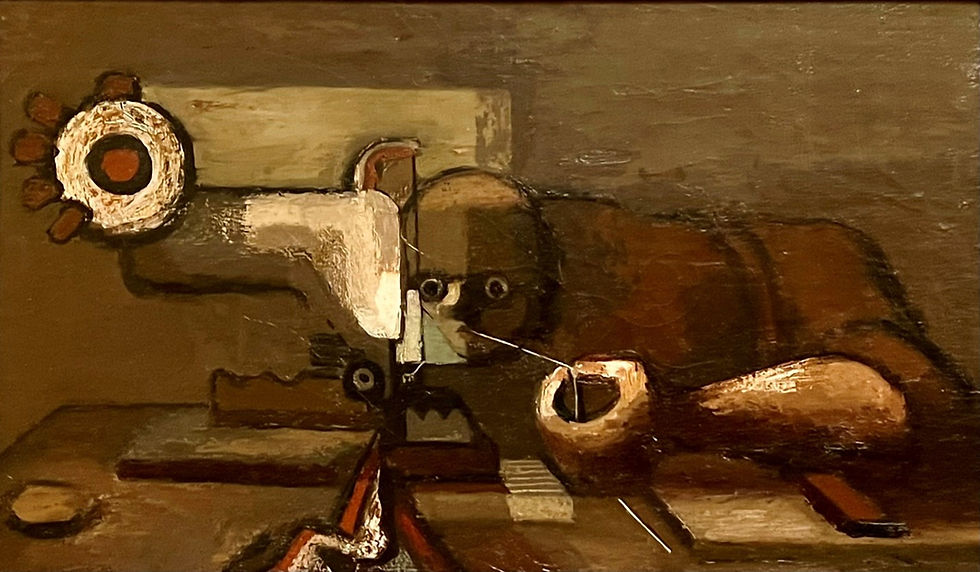
Man at Machine, 1939, oil on canvas, unsigned, 9 ½ x 16 inches, label verso bears artist’s name and address, title, date, size and medium of the painting, exhibited Roszak Early Paintings, Harold Ernst Gallery, Ltd., Boston, MA, April 17 – May 4, 1973 (illustrated in the catalog), presented in its original frame
$18,000
Theodore Roszak was a pioneering Polish-American modernist, who worked as a painter, printmaker, and sculptor. His early work reflected the clean geometry and machine aesthetic of European modernism seen through the lens of the American experience. Man at the Machine is a prime example of Roszak's approach to the integration of labor and sleek, industrial-oriented imagery in which the worker becomes one with the tools of his trade. Concerning this painting, art critic Emily Genauer observed, “There is endless variety and originality in these pictures, extreme sensitivity and great sophistication and taste. Roszak’s compositions may be described as semi-abstractions. The main theme of each is realistic enough, but it is enlivened with all sorts of intricate excursions into abstractions. It may be something small as the hat of the girl in En Masque or the fingers of the Man at the Machine. But in each he builds up complex fantastic, imaginative and beautiful mosaics of form and color and texture, all of which always related to the dominating design of the whole."
Born in Poznań, then part of Prussia, Roszak immigrated with his family to Chicago in 1909. Demonstrating artistic talent at an early age, he studied at the School of the Art Institute of Chicago before moving to New York to continue his education with at the National Academy of Design and privately with George Luks, while also studying philosophy and logic at Columbia University. A fellowship enabled him to travel throughout Europe between 1929 and 1931, where exposure to the Bauhaus, Purism, Constructivism, and the paintings of Giorgio de Chirico profoundly shaped his artistic outlook.
Following the devastation of the Second World War, Roszak's style changed dramatically and during the 1940s and 1950s, he became well known for combining industrial materials with organic, often biomorphic forms to create works that reflected both the technological advances and profound anxieties of the twentieth century. Rejecting purely mechanical abstraction, he developed a highly expressive sculptural vocabulary characterized by jagged welded steel, bronze, and brass forms that evoked both living organisms and fractured machines. These sculptures explored themes of violence, resilience, mythology, and the enduring struggle between destruction and creation. Roszak believed sculpture should embody emotional and spiritual forces rather than simply formal design, making him one of the most distinctive voices in postwar American sculpture.
During his career Roszak taught at the School of the Art Institute of Chicago, Sarah Lawrence College, and Columbia University. He exhibited widely in the United States and internationally, representing the United States at the Venice Biennale and participating in Documenta II in Kassel, Germany. He also completed significant public commissions, including the monumental eagle that crowned the former U.S. Embassy in London. Roszak’s work is held by many of the world’s leading museums, including the Museum of Modern Art, Whitney Museum of American Art, Metropolitan Museum of Art, Hirshhorn Museum and Sculpture Garden, Art Institute of Chicago, Los Angeles County Museum of Art, and Smithsonian American Art Museum. He is listed in Who Was Who in American Art and all other standard references.


Comments